February was chaotic. It began with three things: a shoulder bandage, a birthday trip where I discovered the network connectivity was… almost nonexistent, and the internet telling me that artificial intelligence (AI) might take all our jobs.
Which led me to think a lot about one question — why did I fall in love with technology in the first place?
Let me start with this: AI is a tool. A powerful one, but still a tool.
I recently heard a leader speak at the NASSCOM event that every era has its own technological fears. When computers first entered offices, people worried machines would replace workers. During the internet boom, many believed online platforms would destroy traditional industries and where selfless cars will take over the world ( I saw some in San Francisco but didn’t have the guts to sit in one). And now in the AI era, the concern is that intelligent systems might take over thinking tasks. And Maybe AI will change a lot. But it will also create different roles, industries, and problems that require fresh ways of thinking. If history has taught us anything, it’s this: Change is the only constant.
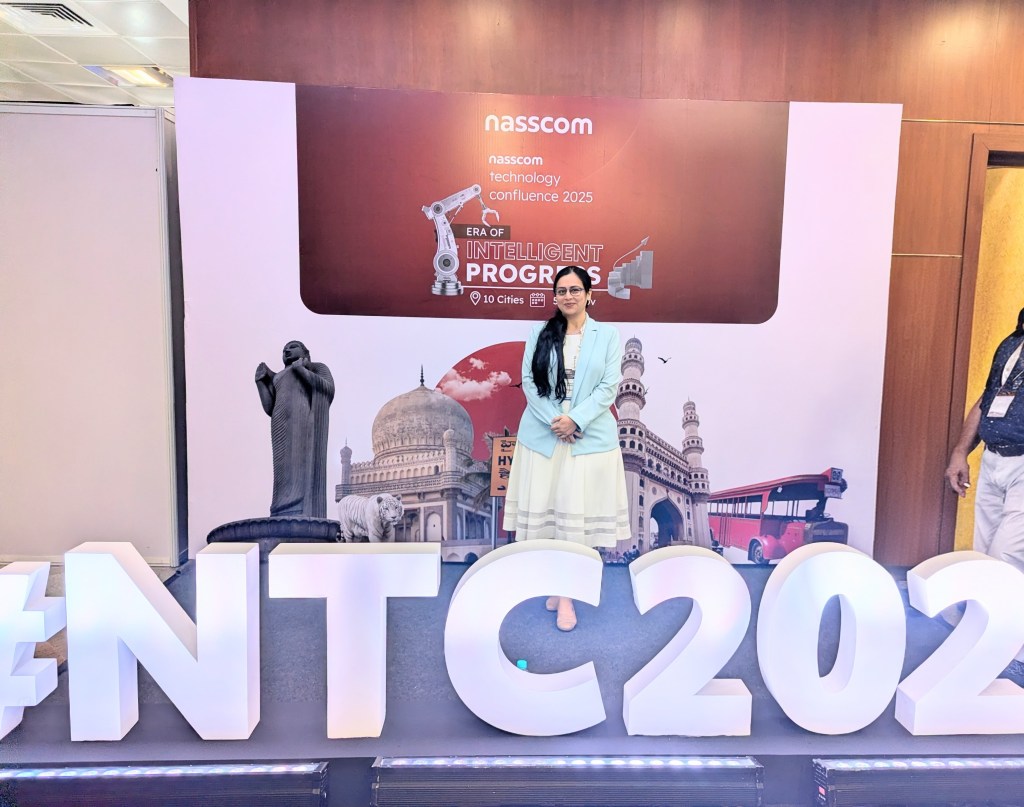
Last night my brother and I were talking about how many people around us are being impacted by the job market right now — layoffs, uncertainty, career transitions. It’s real and it’s hard. But I also believe that periods like this eventually lead to transformation. Different skills emerge. Different roles appear. And people slowly figure out where they fit next.
So instead of worrying endlessly, the only thing we can really focus on is building skills — communication, clarity of thought, the ability to explain ideas well, and the courage to keep learning. Even i am learning and i do have a teeny tiny fear but we take a deep breath and keep going.
Another thing that occasionally makes me anxious is how we are expected to keep up with everything – with so many new frameworks, tools, models coming out in the market, it sometimes feels impossible. I’m part of a book club, and sometimes I feel guilty reading a novel because I think I should instead be learning something technical. And even if i make the time, thenhow will i remember all this? Because there’s a difference between reading something casually and actually trying to understand and retain it. A friend of mine recently wrote about this (https://tinyurl.com/Why-you-remember-nothing) — how the speed of information today creates constant pressure to hustle, learn faster, and keep up. Honestly, I agree – Sometimes the pace feels overwhelming.
And in the middle of all this technological progress, I’m also navigating the world of arranged marriage conversations. Which is fascinating, because while AI models can now predict the structure of millions of things, apparently no algorithm has yet figured out how to predict human compatibility. If someone builds that product, I promise it will sell instantly around the world.
My real introduction to modern AI happened when ChatGPT was released by OpenAI on 30 November 2022. I remember exactly where I was – at home, working remotely. I called my friend and flatmate and said, “You have to see this.” We opened YouTube, watched tutorials, figured out how to use it, and started experimenting. Our first experiment? Knock-knock jokes. Clearly very serious technological research.
Those experiments led me down a rabbit hole of videos about machine learning and artificial intelligence. That’s when I came across the story of AlphaFold, developed by researchers at DeepMind.
For more than 50 years, scientists struggled with a biological mystery called protein folding — understanding the complex 3D shapes of proteins that are fundamental to how life works. Determining the structure of even a single protein in a lab could take years. AlphaFold used AI to predict the structures of over 200 million proteins, dramatically accelerating research in biology and medicine.
This breakthrough contributed to the 2024 Nobel Prize in Chemistry, awarded to Demis Hassabis, John Jumper, and David Baker for advances in protein science and computational prediction.
Think about that for a moment. AI didn’t replace scientists. It gave them superpowers. And it’s not just happening in research labs.
In India, startups like Niramai Health Analytix are using AI-based thermal imaging to help detect breast cancer early, even in remote places where traditional mammography machines or radiologists may not be available. Organizations like Qure.ai use artificial intelligence to analyze chest X-rays and detect diseases such as tuberculosis faster, helping doctors screen patients in crowded hospitals where resources are limited.
I’ve lost people in my life to breast cancer. And my uncle to tuberculosis. So when I read news like this, it stops being just ‘tech news’ and becomes something much more human — the possibility that science might slowly untangle problems that have caused so much pain for families everywhere.
Sometimes the impact of technology shows up in unexpected places — like farms.
In India, millions of farmers depend on the monsoon, and a small shift in rainfall can mean the difference between profit and loss. To help with this, Microsoft worked with researchers at International Crops Research Institute for the Semi-Arid Tropics (ICRISAT) and programs supported by the Government of Andhra Pradesh to build AI tools that analyze weather, soil, and satellite data.
Farmers then receive simple guidance through SMS about when to sow seeds or what crop varieties might work best.
For someone working in technology, stories like this matter. Because somewhere far away from conference rooms and product launches, a small message on a farmer’s phone might mean the difference between a failed season and a successful harvest.
Of course, science is rarely a magic wand. Even John Jumper has mentioned in interviews that AI systems can sometimes be ‘confidently incorrect‘. Which is both comforting and mildly terrifying. Comforting because machines, like humans, can still be wrong. Terrifying because sometimes they sound very confident about it. So yes, AI will change things. But maybe instead of fearing it constantly, we can approach it with a sense of exploration.
And also remember to eat good food with good friends — because honestly, that might still be the most important technology for happiness.
For now, I’m choosing to approach AI the same way I approach life – One day at a time.
Maybe that’s what this birthday month reminded me of that – Technology isn’t just about speed, competition, or keeping up with the latest trend. It’s about solving problems that once seemed impossible. And sometimes it’s about small, quiet moments where an algorithm helps a scientist, a doctor, or even a farmer make a better decision. And when I think about it that way, I remember why I fell in love with this field in the first place.
But because, at its best, technology is simply human curiosity trying to make the world a little better.


I’d love to hear what stayed with you. Leave a comment below—I read all.