“You can read a hundred books about a city. Until you’ve lived a small piece of your life there, you don’t really know it.”
People often say, “Spend your money on experiences instead of things.” For the longest time, I thought that simply meant collecting memories. Now I think it means something else. I think experiences become a language. And once you’ve lived them, a single word, a passing reference, or the name of a place is enough to transport you back.
I realized this while reading The Psychology of Money. Morgan Housel writes about how Chris Rock prepared for his tours. Before performing in arenas, he would test his material in small comedy clubs, performing the same jokes over and refining until they felt right. One of those places was the Stress Factory Comedy Club in New Brunswick.
I actually had to put the book down for a second.
Because I know New Brunswick.
Not because I’d read about it somewhere. Not because I’d seen it on a map. I know it because, for a little while, it became part of my everyday life when I lived barely ten minutes away. It is home to Rutgers University, and to the State Theatre, where I watched my first stage production, The Kite Runner. It’s also where I once rushed for a dental check-up because it was cheaper. (Priorities. 😂)
Funny how memory works. It doesn’t just preserve the milestones. It keeps the odd little things too—a discounted dental appointment, the streets you walked without thinking, the places that quietly became ordinary simply because they were always there.
Looking back, I think we mistake proximity for permanence. We assume there will always be another weekend. Another summer. Another chance. I did that with Central Park. I also did that with Eleven Madison Park, the Michelin-starred vegan restaurant I’d watched documentaries about for years. Every time I wanted to get a reservation, I’d tell myself, Someday.
There was always another weekend. Until there wasn’t.
Turns out, next weekend eventually becomes another country.
Around the same time as reading the book, I started watching The Bear. A friend recommended it because of how beautifully it explores grief, but I stayed because of Chicago. Throughout the show, streets, neighborhoods and landmarks appear almost casually—and each time I recognize one, I catch myself smiling.
Because I know them.
Like… I actually know the streets of Chicago.
Growing up, I always assumed New York would become my favorite city in America. It never did. Chicago quietly stole my heart—not because it has the prettier skyline, but because I lived little pieces of my life there.
It was where I took my first solo trip. I flew in one morning, spent the day at a vegan festival, ate alone for the first time, danced with strangers and laughed more than I expected to. By night, I flew back home because staying alone in a hotel still scared me.
It wasn’t a grand solo adventure. It barely lasted a day.
But courage doesn’t always arrive dramatically.
Sometimes it arrives on a morning flight and leaves on the last flight home.
Overtime, Chicago slowly became the city I’d recommend to friends without opening Google Maps. It became the city where I knew exactly where to eat, where to walk, and which little corners never made it into travel guides. I knew the walk from the Bean to the Riverwalk. I knew where to find the best vegan cookies. I knew the Jamaican vegan restaurant I’d happily take every visitor to.
And then there was Devon Avenue.
If you’ve ever been there, you’ll know. It feels like someone quietly picked up a street from India and placed it in the middle of Chicago. Indian grocery stores. Sweet shops. The smell of fresh samosas. Restaurants I’d recommend without thinking twice. I had walked that street more times than I could count, yet it wasn’t until I took my mother there that I noticed the gurudwara tucked quietly in the middle.
Funny how sometimes we discover old places through new company.
In one of my trips to Lake Superior in Duluth, a group of us drove and like in the majority, I was busy chasing the perfect photograph of the lighthouse when I noticed one friend standing quietly, his phone tucked away. I asked him, “Where’s your phone?” He smiled and looked back at the lake and said, “I don’t know if I’ll ever come back here. I just want to stand here for a while.” I still think about that moment. It is strange how the smallest conversations can quietly change the way we experience the world.
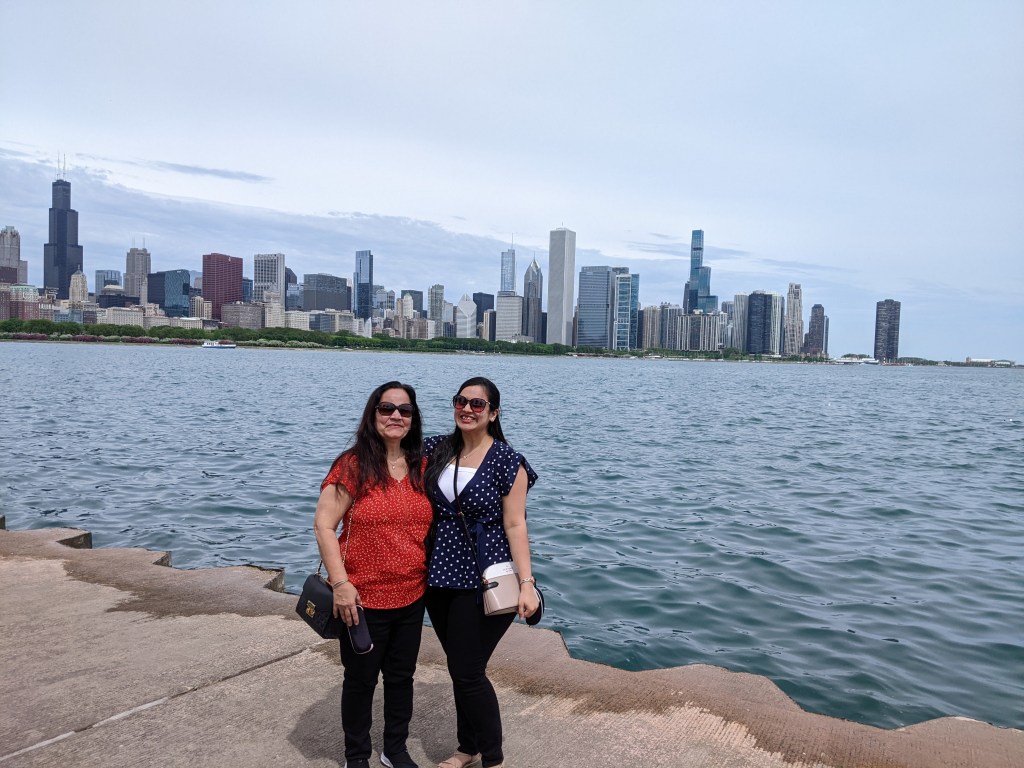
When my mother came to visit me in Chicago, I caught myself saying the exact same thing. Every few minutes she’d stop to take another picture, and I’d laugh.
“I already have photos of all these places.”
“I’ll send them to you later.”
“Right now… just be here.”
And maybe that’s why people often say we should spend money on experiences instead of things. I finally think I understand why.
Experiences don’t just become memories. They become references. They become stories.
Years later, all it takes is someone mentioning a place you once experienced—even briefly—and suddenly, you’re fluent again. Not just in geography, but in memory. They become little pieces of us.
Maybe that is why experiences outlast things. Souvenirs can be misplaced. Photographs can sit forgotten in a folder. But what we have lived keeps finding its way back to us like a language—one that stays with us long after we have left the place where we first learnt to speak it.
A vocabulary for nostalgia.


I’d love to hear what stayed with you. Leave a comment below—I read all.